
With the spooky season upon us, I’m much back into reading classic horror. Edgar Allan Poe has always been one of my favorite horror authors, and “The Masque of The Red Death” may be my favorite tale of his.
“The Masque of the Red Death” is a hauntingly vivid short story unveiled in 1842. This Gothic masterpiece centers on Prince Prospero, a wealthy aristocrat who attempts to evade a devastating plague—ominously named the Red Death—by isolating himself and his fellow nobles in the opulence of his secluded abbey.
Determined to defy the grim reality outside, Prospero hosts a lavish masquerade ball in seven grand chambers, each uniquely adorned in a single, striking color.
But as the festivities crescendo, an uninvited guest—draped in the eerie guise of a Red Death victim—moves ominously through each chamber.
When Prospero confronts the figure in a chilling twist, he discovers nothing tangible beneath the ghastly costume. Soon after, death claims him, and the other revelers in a grim and inevitable procession.
Poe’s tale is steeped in the rich traditions of Gothic fiction, weaving an intricate allegory about the inescapability of death.
However, interpretations of the story vary widely. While many critics view the tale as an exploration of humanity’s futile attempts to escape mortality, others caution against a strictly allegorical reading.
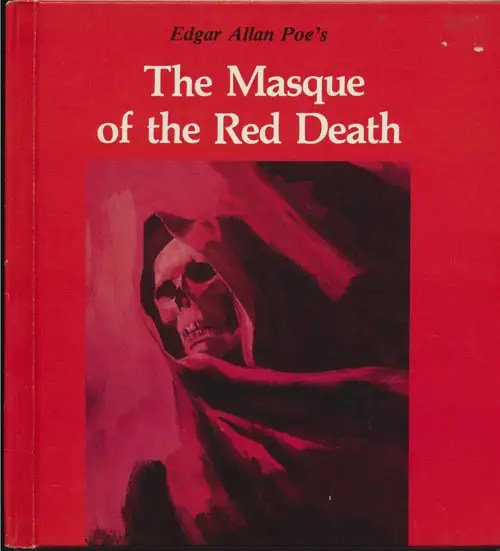
Poe himself was known to dislike didacticism, making the story’s meaning all the more enigmatic. Nonetheless, the vivid symbolism—from the blood-red imagery to the relentless ticking of time—keeps readers on edge, constantly aware of the creeping presence of death.
Published originally in Graham’s Magazine in 1842, “The Masque of the Red Death” has inspired countless adaptations, including a 1964 film starring Vincent Price. Its thematic richness has resonated with creators across various media, making it a cornerstone of American Gothic literature.
The story’s Gothic atmosphere is influenced by earlier works, such as Horace Walpole’s The Castle of Otranto, but Poe takes the genre in a uniquely psychological direction.
The seven color-themed rooms where the masquerade is held have been interpreted as symbolic representations of the human psyche, with each chamber evoking different facets of the human experience.
The imagery of blood and the passing of time throughout the narrative underscores the physicality of life, which is bound by the inevitability of decay and death.
While Prospero’s castle is designed to protect its inhabitants from the ravages of the plague, its oppressive, labyrinthine structure ultimately betrays them. The tall, narrow windows, the unsettling color schemes, and the eerie progression from room to room mirror the false sense of security the nobles cling to.
The stranger’s mysterious ability to enter the sealed abbey suggests that no literal or metaphorical walls can protect us from the universal truth of mortality.
The fictional disease, the Red Death, is described in excruciating detail: it causes sharp pains, dizziness, and profuse bleeding, leading to death in a mere half-hour.
Some interpretations of the story even read it as an autobiographical reflection of Poe’s life. Prince Prospero’s desperate attempt to escape the looming plague mirrors Poe’s struggles with the tragic losses he faced—most notably his wife, Virginia, who was battling tuberculosis at the time he penned the story.
This disease had already claimed Poe’s mother, brother, and foster mother, casting a long shadow over his life. Thus, Prospero’s reckless defiance and ultimate demise can be seen as a reflection of Poe’s tormented psyche.
The fictional disease, the Red Death, is described in excruciating detail: it causes sharp pains, dizziness, and profuse bleeding, leading to death in a mere half-hour. While some scholars suggest the disease may have been inspired by the tuberculosis ravaging Poe’s loved ones, others argue that it could refer to cholera, an epidemic that Poe witnessed firsthand in Baltimore in 1831.
Other theories propose it could represent bubonic plague or even a more abstract concept, such as a symbolic manifestation of original sin or human frailty.
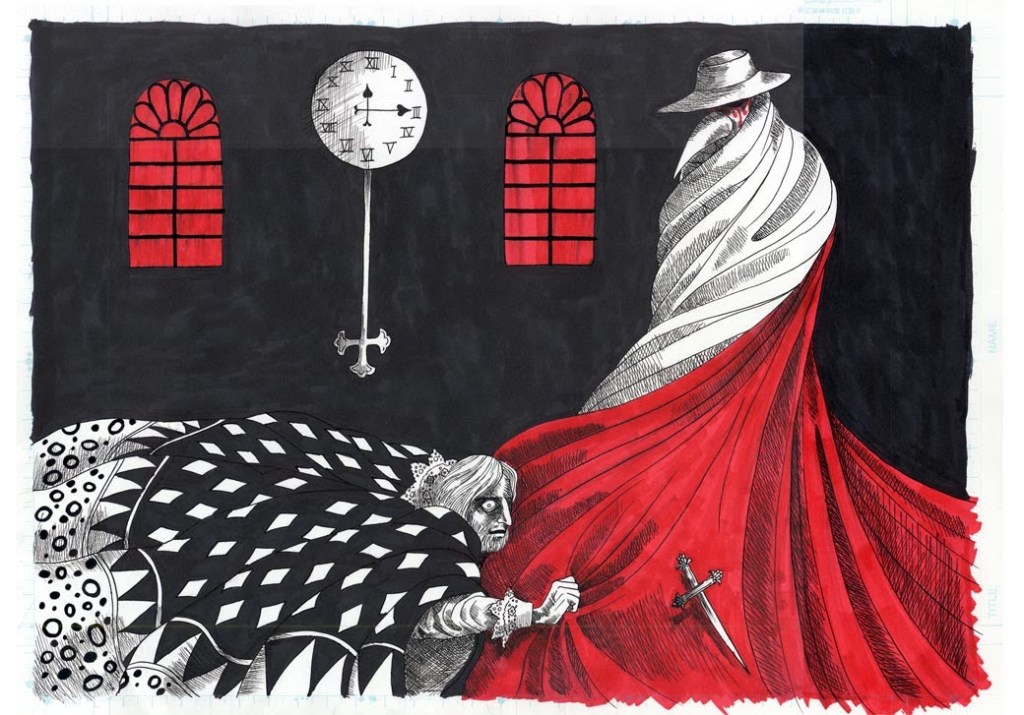
The title itself underwent a notable evolution. Initially published as “The Mask of the Red Death,” the story’s original title emphasized the mysterious figure at the tale’s heart.
However, when Poe revised the story for the 1845 edition of the Broadway Journal, the title changed to “The Masque of the Red Death,” shifting the focus to the opulent, yet doomed, masquerade itself—a symbol of mankind’s tendency to revel in distraction, even as death draws nearer.
In Poe’s masterful hands, “The Masque of the Red Death” reflects human nature, a meditation on mortality, and a work of timeless terror that continues to captivate and provoke discussion more than a century after its publication.
Whether you read it as a straightforward tale of horror or a complex allegory, Poe’s work lingers in the imagination, reminding us all that no matter how extravagant our diversions, death remains the one inescapable guest.

 God Is In The Radio
Leave a comment