Mobile, Alabama, is known as the most haunted city in the state, and it’s easy to see why. Since Europeans first set foot on its soil in 1699, they were haunted by its eerie atmosphere.
But none of its tales are quite as strange and chilling as the one that unfolded in 1834—a story that intertwines friendship, love, betrayal, and an unsettling tree. At the center of it all? A man named Charles Boyington.
A gruesome sight
Charles Boyington was a young dreamer—a printer, a vagabond, and a gambler. In his late teens, he left his home in Connecticut and traveled south, hoping to find fortune in Mobile during the bustling cotton boom of the 1830s.
He found lodging in a modest boarding house, where he befriended a fellow worker named Nathaniel Frost. Together, they navigated the social whirl of dances and balls, trying to fit in with the high society of old Mobile.
During one such event, Charles met a woman named Rose de Fleur, and it was love at first sight. Rose came from wealth, and her father, disapproving of her relationship with a poor printer, forbade it.
But Charles was undeterred. He wrote Rose love poems and spent his days thinking of her—so much so that he lost his job at the Mobile Chronicle. Despite the odds, the two became inseparable.
The next morning, Mobile woke to a gruesome sight. Nathaniel Frost’s body was discovered hanging from a tree, covered in blood and stab wounds.
At the same time, Boyington was caring for his friend Nathaniel, who was suffering from tuberculosis. In return, Frost helped Boyington with his rent, solidifying a bond that seemed unbreakable.
But everything changed on May 10, 1834.
That afternoon, Boyington and Frost were seen walking near the Church Street Graveyard, a quiet, shaded place on the city’s outskirts. When Charles returned home alone later that day, neighbors asked where Nathaniel was.
“In a hurry, I couldn’t wait for him,” Charles responded, brushing off their concern.
Boyington hurried toward the river wharves, where he made a strange purchase: a pair of pistols, a dagger, and other supplies. Later that evening, he boarded the steamboat James Monroe, bound for Montgomery.
The next morning, Mobile woke to a gruesome sight. Nathaniel Frost’s body was discovered hanging from a tree, covered in blood and stab wounds. The city was horrified. The newspapers declared murder, and the mayor offered a $250 reward for the killer’s capture.
‘I am innocent!’
Suspicion immediately fell on Boyington.
Officers mounted their horses and chased the steamboat down the Alabama River, catching up to it just in time. They found Boyington in the ladies’ cabin, casually studying the hand of a man playing cards. He was arrested on the spot.
Back in Mobile, the public was furious. Crowds gathered, shouting, “Kill him!” “Drown him!” “Hang him from a lamppost!” Mob justice was close at hand.
The trial that followed was swift, and Boyington’s defense was dismal at best. With barely competent lawyers by his side, Boyington was found guilty of Frost’s murder and sentenced to die by hanging—the same brutal fate his friend had met. Boyington maintained his innocence, convinced that a pardon would come. But the pardon never arrived.

On the day of his execution, as the noose tightened around his neck, Boyington made one final declaration: “I am innocent! I am innocent! But what can I do? When I am buried, an oak tree with a hundred roots will grow from my grave to prove my innocence!”
And with that, his life ended—but his story didn’t.
The Boyington Oak
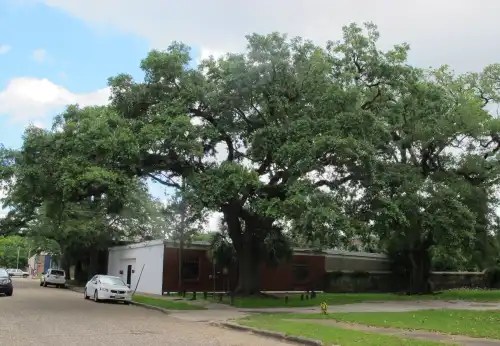
Charles Boyington was buried in the potter’s field near Church Street Graveyard, and as if on cue, an oak tree sprang from his grave.
That tree, now known as the Boyington Oak, still stands today. It’s a towering live oak with sprawling branches, a reminder of the man who swore he was wronged.
In a city full of ancient oaks, the Boyington Oak stands apart, not for its size or age but for the folklore surrounding it.
Over the years, visitors have reported hearing eerie whispers and distant cries around the tree. Whether it’s Boyington’s spirit, still proclaiming his innocence, or just the wind weaving through the leaves, no one can say for sure.
The legend of the Boyington Oak has been told and retold in countless books and stories, cementing its place in Mobile’s haunted history.
From Kathryn Tucker Windham’s Jeffrey’s Latest 13: More Alabama Ghosts to John S. Sledge’s Cities of Silence, the tale of Charles Boyington continues to captivate and haunt the imaginations of those who visit the city.
The next time you find yourself in Mobile, pause beneath the heavy branches of the Boyington Oak. Listen closely; perhaps you’ll hear the whispers of a man who claimed the tree would be his final witness.

 God Is In The Radio
Leave a comment