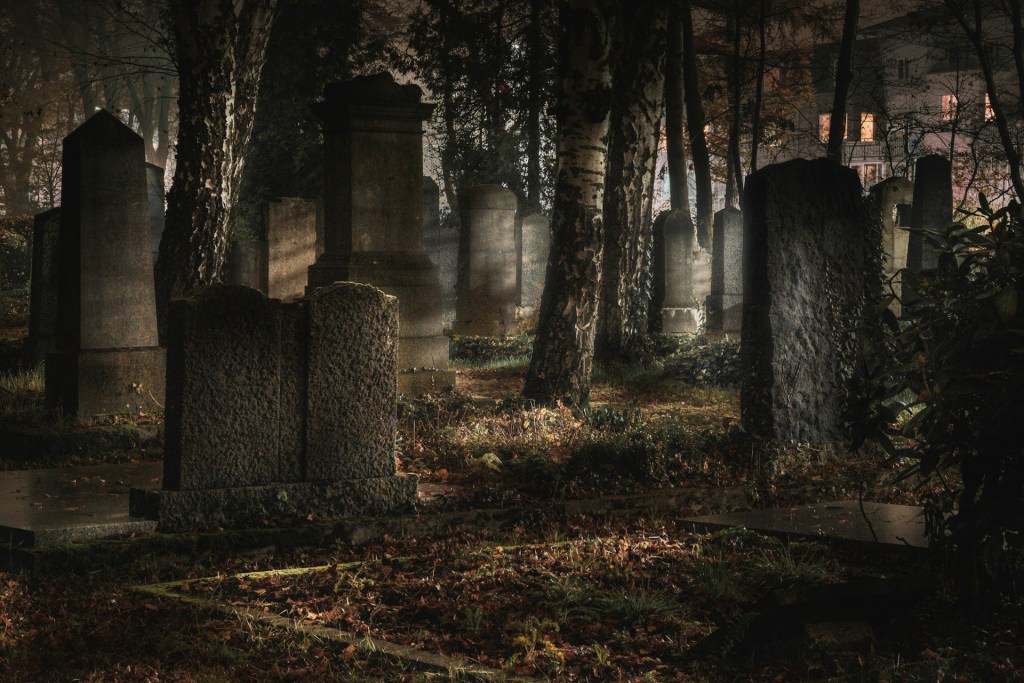
In the town of Ashcroft, an ancient cemetery was sprawling and silent, its iron gates rusted from centuries of decay. Beyond those gates, the gravestones jutted against the sky, marking the resting places of the forgotten.
Many whispered of the spirits that lingered there, but no tale haunted the people more than the legend of the Lady of Sorrows.
They said she appeared only at night, clad in mourning black with a long veil trailing behind her like a shadow woven from grief itself. Her sobs could be heard in the wind, a wail so mournful it chilled the bones of those who dared to venture too close.
Yet, not everyone could see her—only a select few, chosen by some unknown hand, caught glimpses of her sorrow as she wandered the cemetery, weeping for the dead.
These chosen few never spoke of it openly, for the Lady’s presence was considered a curse of silent doom. Once someone saw her, they claimed to hear her sorrow even during the day, as if her mournful cries had wormed their way into their minds, never to leave.
Some said the Lady marked those who witnessed her, that their lives would soon end, drawn down into the depths of the earth by her lament. The town was steeped in superstition, and the Lady of Sorrows became less a ghost story and more a shared dread, hanging over Ashcroft like a perpetual storm cloud.
–
On the edge of town, nestled between the old church and the hollow woods, stood a modest cottage belonging to Abigail Crowley, a young woman with little family and few friends.
Abigail had lived a quiet life, finding solace in the patterns of her work as a seamstress and in the simple pleasures of tending to her herb garden.
But like many in Ashcroft, she had heard the stories. And on some cold nights, when the wind was just right, she thought she could hear something—soft, distant, like a woman crying.
But she never saw anything. She never believed, not truly. Until the fog rolled in that night.
The mist was thick as wool, blanketing the town in an unnatural grayness that obscured everything but the moon’s pale glow. Abigail had been walking home from delivering a repaired dress to old Mrs. Farrow when she found herself drawn, inexplicably, toward the cemetery.
A creeping chill crawled up her spine as she neared the gates, but it wasn’t from the cold. It was something deeper, primal. Her breath turned ragged, and her heartbeat quickened, but her feet moved forward, as if pulled by invisible hands.
And then she saw her.
The Lady of Sorrows.
She was gliding between the tombstones, her figure barely visible through the thickening fog, her long black veil trailing in the air as though it were made of smoke. The Lady’s shoulders shook with each sob, her mournful cries echoing through the stillness, and Abigail was transfixed.
Her eyes couldn’t move away from the tragic figure, her heart pounding with both terror and pity.
Abigail had always been practical, rooted in the tangible, but now, standing in that ghostly fog, her rationality shattered. The Lady of Sorrows was real.
Her wails rose in the air, and Abigail felt the weight of centuries of grief crashing down on her. It was as if the Lady mourned not only the dead beneath the earth but the living, too, those doomed to die, forgotten and buried under the weight of their own lives.
Abigail wanted to run, but she was paralyzed. The Lady’s voice filled her head, reverberating inside her skull, until her legs gave way, and she collapsed to the ground near a stone cross. The mist curled around her like fingers, cold and damp, and still, the weeping continued.
–
Through the veil of her tears, Abigail noticed something—the Lady of Sorrows was not alone. There were shadows, darker than the night, moving among the graves. Wisps of mist coalesced into shapes, indistinct at first but slowly forming human figures. They walked with the same slow, mournful pace as the Lady, their faces hidden beneath ragged cloaks.
They were the dead.
Abigail’s breath hitched. Her mind reeled as she realized she was witnessing a procession of souls, each drawn to the Lady of Sorrows like moths to flame. The dead had risen, not to haunt, but to mourn with her. They were her chorus, the lost and the forgotten, pulled from their eternal rest by her endless sorrow.
The ground beneath Abigail felt softer, colder. The air seemed heavier, filled with the scent of decay, but there was no malice in the dead who wandered. Only sadness. Overwhelming sadness.
The Lady turned, and for the first time, Abigail could see her face. Pale as bone, with eyes like empty voids, her face was lined with deep sorrow, and her lips trembled as they whispered unintelligible laments for all she had lost.
And then the Lady looked directly at Abigail.
Time seemed to stop. The air grew still, and Abigail felt the pull of those dark eyes, beckoning her closer. There was something unnatural about the moment, something Abigail could not escape.
The Lady’s gaze bore into her, as though she saw every pain Abigail had ever felt, every regret, every fear of death that had gnawed at her over the years.
“Why do you mourn?” Abigail whispered, her voice trembling.
The Lady’s weeping ceased for a moment, and the night grew eerily silent. She tilted her head, her hollow eyes unblinking.
“I mourn all,” the Lady whispered, her voice as soft as the wind rustling through the dying leaves. “I mourn the living and the dead. I weep for those who remember, and those who are forgotten. I weep for you.”
Abigail felt a cold shiver run down her spine. She struggled to her feet, heart pounding, but her legs felt heavy. She stumbled backward, desperate to escape the Lady’s gaze, but the figures of the dead shifted, closing in around her.
Her breath came in sharp gasps. She could feel the cold touch of the Lady’s sorrowful presence wrapping around her, pulling her down, as though the earth beneath the cemetery wanted to claim her too.
The Lady raised a hand, her long, skeletal fingers reaching out toward Abigail. She felt the cold brush of those fingers against her cheek, and for a moment, time stopped. Abigail saw everything—the passage of countless years, lives lived and lost, souls wandering through eternity with no one to remember their names.
And she realized, with a sharp clarity, that the Lady of Sorrows did not simply mourn. She carried the burden of all grief, for every soul that had passed through this world. She wept because no one else would.
–
As the dead crowded closer, their ghostly forms almost brushing her skin, Abigail felt a sudden surge of defiance. She did not want to join them. She would not.
She broke free of the Lady’s gaze, stumbling backward through the mist, past the tombstones, her legs trembling but moving.
The Lady did not follow. She merely stood there, her hand falling back to her side, the tears beginning to stream down her face once more.
The sobs resumed, filling the night air, but they grew distant as Abigail ran from the cemetery, her heart pounding in her chest. Behind her, the Lady’s weeping continued, a sorrow that would never end.
Abigail didn’t stop running until she reached the safety of her cottage. Breathless, she collapsed against the door, her mind reeling, her body trembling.
But even as she locked the door and collapsed onto her bed, she could still hear it—the Lady of Sorrows, weeping in the distance, mourning the dead, mourning the living, mourning all that had been and all that would be.
And though she had escaped the cemetery, Abigail knew she would never truly be free from the sound of the Lady’s sorrow.
–
When Abigail ventured back into town the following day, she did not speak of what she had seen. But her eyes, once bright and warm, now held a deep sadness that echoed the grief of the Lady herself. And though she never returned to the cemetery, she could hear the wails at night, low and distant, as if calling to her—reminding her that some sorrows could never be left behind.
In Ashcroft, the Lady of Sorrows still wanders. And those who hear her weeping know that death, and the grief it leaves behind, is a burden shared by all.
The End

 God Is In The Radio
Leave a comment